
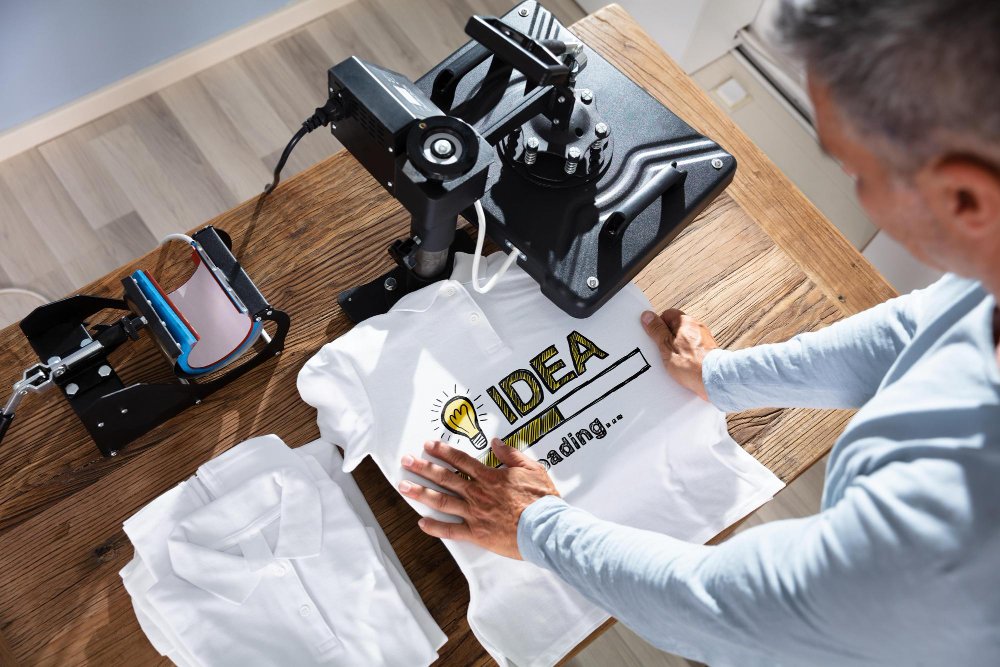
When putting a logo or design on clothing, businesses and apparel brands often have to choose between custom embroidery and screen printing.
Both methods can produce professional results, but they work differently.
Embroidery creates a design using thread, while screen printing applies ink to the surface of the garment. The right option depends on your artwork, garment, placement, desired appearance, fabric, and budget.
This guide explains the key differences between custom embroidery and screen printing so you can choose the method that fits your project.
What Is Custom Embroidery?
Custom embroidery uses thread to reproduce a logo, name, design, or artwork on a garment or other material.
Before production, the artwork is converted into a machine-readable embroidery file through digitizing.
The file controls details such as:
- Stitch direction
- Stitch density
- Stitch sequence
- Thread colors
- Underlay
- Design size
Custom embroidery is commonly used for logos on:
- Polo shirts
- Work shirts
- Jackets
- Hats
- Caps
- Uniforms
- Bags
- Hoodies
What Is Screen Printing?
Screen printing applies ink to a garment through a prepared screen.
It is commonly used for:
- T-shirts
- Sweatshirts
- Hoodies
- Promotional clothing
- Large graphic designs
- Multi-color artwork
Screen printing can be particularly useful for designs that contain large areas of color or detailed graphics that are not ideal for embroidery.
What Is the Difference Between Embroidery and Screen Printing?
The main difference is how the design is applied.
Embroidery uses thread and stitches.
Screen printing uses ink.
This creates different visual textures, durability characteristics, and design possibilities.
| Feature | Custom Embroidery | Screen Printing |
| Material | Thread | Ink |
| Appearance | Raised/textured | Flat/smooth |
| Best for | Logos, lettering, uniforms | Graphics, illustrations, large artwork |
| Common products | Caps, polos, jackets | T-shirts, hoodies |
| Small logos | Often suitable | Can be suitable depending on detail |
| Large graphics | Can become stitch-heavy | Often more practical |
| Texture | Raised | Smooth |
| File preparation | Embroidery digitizing | Screen/print artwork preparation |
When Should You Choose Custom Embroidery?
Embroidery can be a strong option when you want a textured, professional appearance.
1. For Business Logos
Embroidered logos are commonly used on uniforms, polos, jackets, and workwear.
2. For Caps and Hats
Embroidery is particularly suited to hats and caps, including specialty techniques such as 3D puff embroidery.
3. For Premium-Looking Branding
The raised texture of thread can create a distinctive appearance that works well for many brands.
4. For Names and Lettering
Embroidery can be used for names, initials, team numbers, and other text-based designs.
When Should You Choose Screen Printing?
Screen printing may be more suitable for large graphic designs.
Large Artwork
Large front or back graphics can be easier to produce with screen printing than dense embroidery.
Detailed Illustrations
Some artwork contains details and color areas that are better suited to ink than thread.
Lightweight Designs
Screen printing can maintain a relatively flat feel compared with heavily stitched embroidery.
Is Embroidery More Durable Than Screen Printing?
Durability depends on the quality of the production, garment, materials, care, and application.
Embroidery uses thread stitched into the material, while screen printing applies ink to the surface.
Instead of assuming that one method is always more durable, evaluate the specific garment, design, material, and intended use.
Is Embroidery More Expensive Than Screen Printing?
There is no single price difference that applies to every project.
Cost can depend on:
- Design complexity
- Number of colors
- Design size
- Stitch count
- Number of garments
- Garment type
- Production method
- Setup requirements
A small embroidered logo may be practical for uniforms or polos, while a large multi-color graphic may be more suitable for screen printing.
The best choice depends on the complete project rather than the decoration method alone.
Can You Combine Embroidery and Screen Printing?
Yes.
Some garments use both techniques.
For example, a hoodie could have a small embroidered chest logo combined with a large printed back graphic.
This approach can give brands more flexibility when creating branded apparel.
What Designs Work Best for Embroidery?
Embroidery is generally well suited to designs such as:
- Simple logos
- Bold lettering
- Monograms
- Small brand marks
- Hat designs
- Uniform logos
- Patch designs
Very small details may need to be simplified so they can reproduce clearly in thread.
Why Is Digitizing Important for Custom Embroidery?
An embroidery machine needs stitch instructions rather than a standard image file.
Professional digitizing converts the artwork into a structure that can be embroidered.
Thread Genix states that its manual digitizing process considers stitch density, underlay, pull compensation, pathing, fabric behavior, and different embroidery techniques.
This is important because an artwork file that looks perfect on a screen does not automatically guarantee a clean embroidered result.
How to Choose Between Embroidery and Screen Printing
Ask these questions before selecting a decoration method:
What Type of Design Do You Have?
A small logo and a large illustrated graphic may require different approaches.
Where Will the Design Be Placed?
Caps, chest logos, sleeves, jackets, and large back graphics can have different requirements.
What Fabric Are You Using?
The garment material can affect how the decoration performs.
What Appearance Do You Want?
Choose between a raised, textured embroidered appearance and a flat printed appearance.
How Large Is the Design?
Large, dense embroidery can require significantly more stitching than a small logo.
Custom Embroidery Checklist
Choose embroidery when your project benefits from:
- Raised texture
- Thread-based branding
- Small or medium logos
- Hat or cap decoration
- Uniform branding
- Names or lettering
- Premium-looking logo applications
Consider screen printing when your project requires:
- Large graphics
- Large areas of color
- Detailed illustrations
- Flat graphic decoration
- Large front or back artwork
Create Custom Embroidery With Thread Genix
The right decoration method depends on your design and the final product you want to create.
If you choose embroidery, the quality of the digitized file plays an important role in the final sew-out.
Thread Genix provides professional embroidery digitizing for logos, lettering, caps, 3D puff designs, patches, portraits, and other custom embroidery projects. The company also supports major embroidery machine formats and offers manual, in-house digitizing services.
Submit your artwork to Thread Genix and get an embroidery-ready file designed around your project requirements.
FAQs
Is embroidery better than screen printing?
Neither method is universally better. The right choice depends on the design, garment, placement, appearance, fabric, quantity, and production requirements.
Is embroidery good for logos?
Yes. Embroidery is commonly used for logos on polos, uniforms, jackets, caps, hats, bags, and other garments.
Can embroidery be used on hats?
Yes. Hat and cap embroidery is a common application. Specialized cap and 3D puff digitizing can be used for suitable designs.
Can a detailed image be embroidered?
Detailed images can be converted into embroidery, but some details may need to be simplified depending on the size, fabric, and stitching requirements.
Can I combine embroidery and screen printing?
Yes. A garment can use both embroidery and screen printing when the design calls for different decoration methods.
What is embroidery digitizing?
Embroidery digitizing is the process of converting artwork into a stitch file that an embroidery machine can read.